Friday, February 24, 2017

Winter 2016 to 2017

The Boat is on the Hard with its cover on.
The cover is on tight

Checking out the Saildrive and Prop


Inside "The Tent"

Additional winter pictures of Calypso in the winter of 2016

Getting Across on the Ferry

Coming into Port Jefferson Harbor

In Port Jefferson Harbor

Here is a list of the Work Completed over the Winter of 2016 to 2017

I will be updating this post once winter turns into early spring and the yard and I can start working down the list some more.

During the late fall some work got done on Calypso including:

Repaired Forward Hatch: The large forward hatch (shown opened in the following picture) was leaking badly, enabling mildew to form on the mattress below it; not a good thing, as the mattress is a "tempur pedic" style foam mattress.  The yard's personnel were able to find the leak and repair the hatch.  Now I will need to check it this coming season, but I expect that they have repaired it and it won't leak...they have been very good with all of their previous work.
The Forward Hatch in the open position

Repaired rotting walls:  Once we found the leaks in the cooling system and after I watched the base of the bulkhead not fill with water over most of the summer, Mike and I started to repair the damage.  As shown below.

The Wall into the Head before
The Wall into the Head After
Rotted Wall Base

Detail of rotted area in the Wall
Reconstructed Wall Base
Acquired Mattress pads for cabins: Given the quality of the mattresses on the boat and the fact that they were getting continually more soiled, I decided to protect them with mattress pads that could be taken off and washed.

Getting Mast Lights working: Since I've had the boat all or half of the navigation lights on the boat's mast have not worked.  The yard tells me that they now have almost all of them working.

Tighten Keel Bolts: On the C&C 121's the keel is bolted onto the hull.  Many boats are constructed this way.  Occasionally, these bolts have to be tightened.  I had to have it done twice on Starwood in the 20 years I had the boat.

Repaired Radar: Getting and keeping the radar working has seemed to be a constant repair job in 2016, after not having any problems before that.  Cliff, the electrician, found that a wire had been crimped and that knocked the radar out this last time--more learning for me.

I will update this as we get further into the work in the Spring

Wednesday, January 18, 2017

Thoughts on C&C 121 and SV Calypso

When I first saw pictures of the C&C 121 in 1999 I fell in love with it.  After acquiring one in unreasonably rotten condition (as can be seen from the posts on this blog) I'm still in love with it and especially Calypso.  Why?

Having sailed for over 60 years raced sailboats for over 55 years, I was and am particularly interested in the speed and sail handling characteristics of the boat, even though I had decided to not race the next boat, but to get into cruising.  Since or maybe even before I was 8, when I first read Joshua Slocum'sSailing Around the world alone, I was interested in sailing hither and thither over the oceans; in other words, cruising.  Actually my sister reminded me of this in a recent phone conversation.

Being 8, I decided that O'Day 23 to 25 would be ideal. By the time I was 12, my focus had changed to a Pearson Trident yawl --I liked the idea of having two masts.  However, when I was 12 I had saved enough money through working as a paper boy, moving lawns, and saving my small allowance to buy a sailfish kit boat.  I named it Wet Fanny.  That started my racing career.

Fast forward 55 years.  During that time I had raced and maintained a sailfish (low maintenance), sunfish (no maintenance really and for me, no repairs), a wood lightning (constant maintenance of a wood boat, a new mast for racing, new sails as often as I could afford them), an 0'Day 23 (constant maintenance of the wood--I any boat in saltwater takes four time the maintenance of a boat in fresh water), and a C&C 34, Starwood (with its wood trim requiring significant yearly maintenance).

However, I still considered Starwood for cruising.  Since she was built in 1980, with 1980 vintage primary and secondary winches (for which it is increasingly difficult to get parts), a 1980 vintage engine, which worked exceptionally well, but which the yard said I should replace for cruising any distance, and many other items to replace or upgrade (i really would need an autopilot), I figured the total cost of all the replacements and upgrades would be two and one half times the maximum I could sell the boat for.  Part of that is because I would want everything on the boat to be first class, which is the way I treated Starwood as a racing boat.  And the boat was small for a coastal and/or blue water live aboard cruising boat.  So I looked around for a new boat that would meet the following requirements in no particular order.

The Requirements

1. Big enough to cruise comfortably--I wanted a boat that 2 to 5 people could sail on for two weeks minimum without too many vehemently intense discussions.
.
2. Easy to sail single handed--I should be able to handle all the sails from the cockpit.  For me sails include the main (with 2 reefing points), a number 2 jib, and a code 1 spinnaker.  For me being able to work a spinnaker single handed means that I needed a bowsprit, particularly a retractable bowsprit.  The reason that I worked on getting both my code 0 and code 3 asymmetric spinnakers to roller furl on Starwood.  I had previously tried out other methods, like a spinnaker sock, for dousing a chute and found it frustrating at best and frequently infuriating, and occasionally dangerous.  I also found that on Starwood, when the roller furling worked properly it's simple.  On Starwood, without a bowsprit, it frequently did not work properly.     

3. No exterior wood--it looks beautiful but requires constant maintenance to look beautiful, and I want to sail the boat not constantly maintain it.

4. Fast--A slow deep hulled "seaworthy" boat is good if you like spending many nights going bumpity, bumpity, but I would rather get there and avoid the bumpity.  In other words, I wanted a boat that could avoid, for the most part, serious storms at sea.  And fast in light air.

5. Livable--I wanted some of the comforts while cruising.  For example, Starwood was designed so the entire head would become a shower stall.  Unfortunately it would still need a hot water heater and a shower head (other upgrades for cruising).

6. Maintainable mechanical and electrical systems--On Starwood, the mechanical systems were mainly under the deck and difficult to get to, especially the port side of the engine.  And because others before me had changes electrical components and systems, the wiring was a mess.

7. Up-to-date and complete electronics--This is a very hard requirement to meet because electronics becomes completely obsolete within 3 years of the time its introduced. So, I decided to revise the requirement to a "must meet" of supporting the latest NMEA 2000 standard for interoperability of the electronics.  This should include an autopilot both for safety when sailing along or with only one other and for convenience.

8. The ability to get from the deck into the water and back without a boarding ladder--I wanted a stern swim platform for three reasons, two dealing with safety.  The first is that in case someone falls overboard they can climb onto the swim platform, then onto the deck. The second is that it aids in get off and back onto the boat from a dinghy.  The third is that it will allow me to easily get into the water to clean the bottom of the boat, if and when i'm on an extended cruise.

9. Good refrigeration--This may be a sub-requirement of liveability, but having electric cooled refrigeration was important to me because when I sailed on even relatively short cruises on Starwood, and before that, it seemed I was always in search of ice.  On an extended cruise there may be no ice houses floating around just waiting for me.

10. Self contained and sustaining electrical and water--For extended coastal or blue water cruising it seems to me that having a source of electricity on a boat, not based on burning of potentially expensive and heavy fuel was a must.  So I gravitated to solar panels.  With respect to water for long cruises, I think that a watermaker must be high on the list for two reasons.  The first is safety, it's nice to have water if something untoward happens.  The second is that its nice to be able a shower ever once in a while without counting drops.

11. Saildrive--I wanted the boat to have a sail drive because it greatly reduces the space needed for the engine and drive train, while not really increasing the drag on the boat.

12. Color--While I suppose any topside finish would do, I really liked the Awlgrip finish that I had the yard put on Starwood, a Flag Blue color.  After fighting oxidation of the gelcoat on both the O'Day 23 and Starwood, (I would spend more than a month fighting polishing on the topsides of Starwood and it would look good for maybe a week at most), I had her refinished in Awlgrip.  For the 10 years following, I could polish the topsides in at most, two days, and they would look sparkling for the summer.  It is looks good for the new owner.

There may have been others, but these are the ones I remember.

The C&C 121 and the SV Calypso

As I said earlier, I had my eye on the C&C 121 since 1999.  When I finally decided to replace Starwood, I looked on line for a C&C 121.  After looking at three, each of which was fairly expensive and which came no where close to the boat I wanted, SV Calypso came up for sale.  Theoretically, it meets all of the requirements, above or at least has space so they can be implemented.

However, as you can see from the last two winters of work (and some in the summer), the boat was in bad condition, far worse than I imagined, even taking into account, a deaf and blind surveyor working in the seller's interests.  Still, with a lot of remediation of all of the systems, Calypso is beginning to meet the requirements.

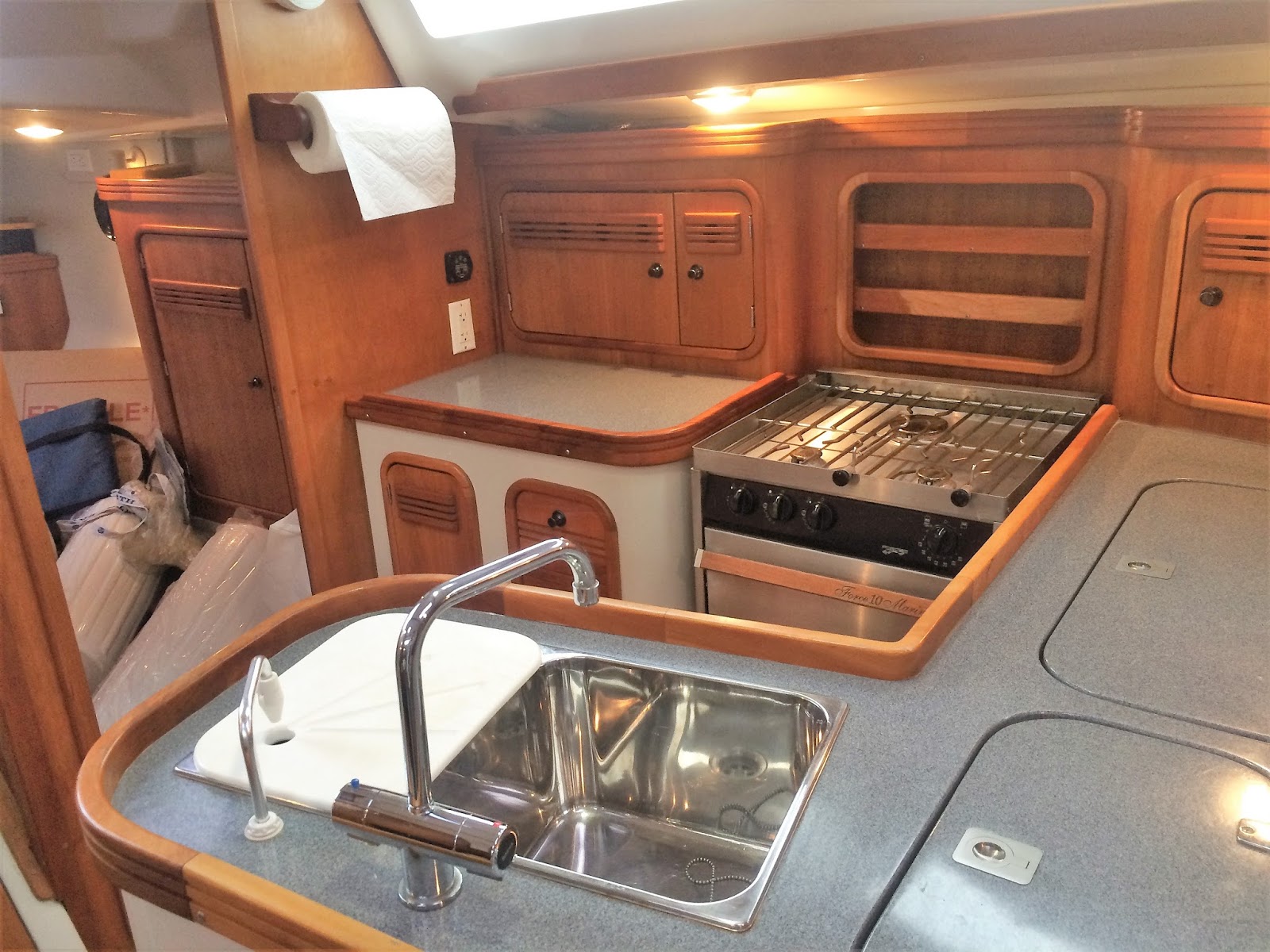
1. Cruise Comfortably-- Calypso has two cabins that can house two people and if necessary an insert that can turn one of the saloon setties into another bed.  So it can serve 2 to 5 crew members.  It has a head with a separate shower stall, and a reasonably equipped galley (including a microwave, which was not a requirement of mine but would most likely be now). Additionally, it has a TV and DVD player (which I would never have thought of for a boat) that I've been told is a nice thing to have on a cruise.  Finally, the boat has tempur pedic style mattresses and air conditioning, neither of which I would have ordered if I had purchased the boat new, but now, after reading and watching Youtube videos I realize can may life on a cruise much more enjoyable and relaxing.
The forward Cabin

The Galley
2. Easy to sail--After racing 55+ years, the last 10 with a fairly complete sail inventory, I decided that my cruising boat would have a roller furling jib, roller furling spinnaker, and all of the control lines led to the cockpit.  The C&C 121 was constructed with most of the control lines led aft to the cockpit through a tunnel under the deck.  This means that the deck is clear of lines.  The lines end up under the dodger in sets of line stoppers.

Starboard stoppers

Port Stoppers
There are still two lines that need to be run back, the tack reefing points.  I will get this done by 2018, I hope this spring.  Then all of the control lines will be ending in the cockpit.

3. No exterior wood--Given the issues I had with maintaining the exterior wood I had on my two previous boats, I'm very happy that this boat has none.  Yes there is a lot of bright work to polish and wax, but I found myself doing that on Starwood.

4. Fast--From everything I could tell and everything I could read, the C&C 121 is fast.  I didn't know how fast.  It's very fast for a racer/cruiser.  As I showed in the video on my Summer 2016 post, in 15 to 20 knots of wind, the boat was moving at close to 10 knots just with a 10 year old #2 jib up.  And I know that on the first sail from Salem MA, where I acquired the boat that we made 75 miles in 9 hours, including 3 hours going through the Cape Cod Canal at 3.7 knots over ground under power and against the tide to Ascent Bay. Since the instruments weren't working properly the first day and since I didn't know much about the instruments, I'm really not sure how fast we were actually going.  But the thing that has astonished me more is the speed of the boat in light air.  The video below shows that we were making about 5 knots in a 6.5 wind (a wind that was off the water.  So while this isn't nearly the speed of today's flat out racers, this more than fulfills my requirements, especially when you consider all of the weight in comforts and conveniences carried by Calypso. 


Going 5 knots through the water in a 6.6 knot breeze
(Nice to have a clean bottom)

5. Livable--I suspect that you can see from my description that it's easy to see that the C&C 121's interior has been designed for being able to live aboard for extended periods.  For a boat of its size, the designers and engineers did an excellent job.  There is a shower stall in the head with pressurized water, factory installed air conditioning that I can use in a marina, and so on.  So the C&C 121 and Calypso is quite livable.  

6. Maintainable mechanical and electrical systems--As I stated earlier getting to and working on the mechanical and electrical systems on the O'Day and Starwood was difficult for me.  I'm not really good at "fixing" things because of my lack of both small and large motor coordination.  But, on both boats the systems, such as they were, were buried in places only a contortionist could reach most of the time.  Those were good places for them until I had to try to work on them.  Even the coordinated friends I had help me (thanks all) had problems. However, in so far as possible on a boat of its size, the C&C 121 is well designed for maintaining the mechanical and electrical systems.

7. Up-to-date and complete electronics--This really isn't a requirement, its wishful thinking as I've found out many times in the past.  By the time you get the latest and greatest, the electronics industry has made it obsolete.  Fortunately on the Calypso, the instrumentation had been updated in 2012 to the NMEA 2000 standard.  This should mean that for the foreseeable future, I should be able to update the electronics as necessary and as I can afford it. 

8. The ability to get from the deck into the water and back without a boarding ladder--The C&C 121 was constructed with a retractable swim platform.  This would fulfill this requirement except that the actuator mechanism seems to be a weak point of the design. All four of the boats I looked at had problems with the actuator.  From the previous posts you can get an idea of the problems I've had in getting it repaired and working again.  I'm still working with the yard to get ameliorate the problem of saltwater getting into the mechanism.

9. Good refrigeration--The C&C 121 was designed with a refrigerator of good size, at least when compared with the icebox on the C&C 34 (another thing that I would have had to add for long distance cruising is the refrigeration mechanism).  As you can see reading some of my previous posts, the actual refrigeration unit on Calypso was worn out and malfunctioning. Now that i've replaced it, it should be good as long as I have the boat.

10. Self contained and sustaining electrical and water--The C&C 121 was designed and constructed before the advent of price competitive solar panels or relatively small, but efficient watermakers.  Additionally, the available amp hours from the batteries onboard is relatively small.  So I may need to upgrade that.  With respect to a watermaker, right now there is some disagreement on whether a watermaker is required.  Since I still have time to decide, I haven't made a decision; partially from procrastinating and partially because watermaker technology is changing.  So it makes sense to wait. 

11. Saildrive--The C&C 121 was design and constructed from the get-go using a saildrive.  And so far, I really, really like it.

12. Color--While Calypso has an Awlgrip finish (and in Flag Blue), the boat has been nicked, banged and scraped to the point that it needs to be refinished (additionally there are some tiny cracks in the topsides that need some work before they get worse). 

Overall, for me, my budget, and my requirements, the C&C 121 is a spectacularly good design and Calypso has more than I thought I wanted in a boat of its size.

Friday, December 16, 2016

Summer 2016

Getting to the Boat

I have an interesting method for getting to the boat in Milford CT from Long Island.  I drive to the Bridgeport/Port Jefferson Ferry, walk on as shown below.
Getting on the PJ Ferry
(This is Actually in Bridgeport)

Going across the Sound
Walking to the train station
(Notice the Ferry in the Background)
Getting on the Train
Going up Two Stops
(Sometimes with a Friend like Alex Snedden shown here)

And finally walking a few blocks to the Marina
I start to work on the Boat

Not a Good Spring

2016 was not a good spring (or year for that matter) for me, health-wise.  The first thing that happened was that I came down with a case of bronchial-pneumonia just before I was to start working on the boat.  It was a month before I felt I could start working on the boat; so that put me 4 weeks behind.  Consequently, I started working long hours to get me back on schedule...bad idea.
Up my Big Ladder Working
I was just finishing polishing the topsides when I decided to use a light aluminum ladder, in the yard to finish the last bit of the transom.
"The Ladder"
The ladder collapsed under me.  Down I went hitting my head on another boat on the way down: concussion time.  It took me two weeks to feel good enough to start work again.  Then I had a recurrence of the bronchial-pneumonia.  Finally, four weeks after that and paying the yard to complete the work, the boat was ready to sail back across the sound.

Got the interior all ready to go with a great deal of help from my friend.


The cabin sole (floor) is looking good

Ready to sail back
Sailing Calypso Back from Milford
In Mount Sinai Harbor
Pictures of and from the boat over the summer


The Swim Platform Actuator
I finally got the swim platform actuator and motor out (together with a faulty switch) and had them repaired and replaced.  If finally works reliably 

Pictures from our single cruise to Essex CT.


That's it for this summer.  We'll see what the winter and next summer brings.

Wednesday, December 14, 2016

Winter of 2015 to 2016

Taking the Boat back on a Supposedly Ugly Day
Supposed to be Windy: Hardly enough wind to sail

Just floating along in what was supposed to be bad weather

Then the blue sky appeared
At Milford, Under Wraps with the Mast Out

Here is a list of the Work Completed over the Winter of 2015 to 2016

These are in no particular order. Additionally, it shows the number of systems that are important for cruising that were much less important for racing.

Repair  and refinish Teak and Holly Sole: One of the things that struck me about Calypso, and all three other C&C 121's that I looked at was the poor maintenance of the wood work, in particular the cabin deck (or sole).  It was discolored with many "water spots".

The Boat in disarray because I pulled the floor boards out and took them home.
Refinishing the floor boards

Working on the deck on Christmas Day, one of the better Presents from mother nature for Me
Calypso out of the Water with Its Mast Down
Added a Serpentine pulley kit to the Engine: As noted in a previous post, the alternator/water pump belt on the engine were going into self destruct mode rapidly because the 100 amp (after market) alternator was putting too much drag on them.  After fooling around with replacing the belt and reducing the amperage put out by the alternator through voltage regulation, I decided it was time to solve the problem through the alternator manufacturer's solution, a serpentine pulley kit for the engine.  The installed kit is shown in the picture.  So far it has worked.
The Serpentine Belt and one of the Pulleys
Replaced the Lifesling Bag: When I acquired Calypso it had Lifesling as the throwable safety device attached to the stern pulpit of the boat.  Apparently it had been on the stern pulpit since the boat was originally put in the water in 2003 because it was in a state of advanced deterioration.  I got a new bag as a Christmas present.

Check the Binoculars: I could never seem to get the binoculars that I bought when I first acquired Starwood to work right.  So I thought that I might have to replace them.  But after finding a copy of the manual for the binoculars online, I found that it was a short circuit between the users ears rather than a problem with the binoculars.

Water in Saildrive: In the winter 2014-5 the mechanic found some milkiness in the saildrive lubricant and change a couple of seals.  Toward the end of the 2015 summer, I again found the milkiness and it got worse quickly.  So the mechanic completely disassembled it and replaced all the seals.

Replaced the Bow Pulpit: As I showed in my last blog (Summer of 2015) a storm came through, a boat drgs its mooring and smashed the bow pulpit.  Over the winter it was replaced with a new bow pulpit.

Repaired Saltwater Vent Loop for the Engine: During a fall inspection of the boat, the mechanic found that a hose for the saltwater vent loop of the engine had sprung a leak. And it was leaking first on the charger/inverter (which caused the C/I problem) and then into the footing for aft cabin wall (which caused the bottom of the wall to rot away).  So three problems were resolved.

Repair Engine Water Strainer: Additional the strainer on the engine water intake was repaired.

Speed/Depth Sensor Thru Hull Calking: In checking out the boat after it had been pulled for the winter, I noticed that the calking was pulling away from the housing for the speed/depth sensor as shown in the following picture.  It was repaired.
The White Calking is splitting off the sensor housing

Fixed LPG tank and valve: Even after replacing the gas sensor for the stove/oven, the gas was not flowing freely to the stove; it took 10 to 20 tries to get it fired up.  Further, I could not get the LPG tank out of its enclosure.   I had the repairs done and the tank replaced.

Updated the Chartplotter software and hardware: When I acquired Calypso it had instruments that did not allow the chartplotter on the deck to display the radar.  So I updated the instruments and had my friend Alex help me to install them.

Replaced lights with LED lights interior: As part of my updating of the electrical systems, I continued to change the interior lights from halogen to LED bulbs; halogen uses a great deal of electricity and become very hot, while LED bulbs use little electricity, last a long time, and produce no heat.

Added Blocks to the Boom Harness:  Over the summer of 2015 I discovered that my first design for a boom harness did not work as I expected to, so I revised the harness by adding blocks to allow better tightening of the harness.  Over the summer I found that I will still doesn't work as well as I would like.

Added a Flag halyard: Most cruising boats the size of Calypso come with flag halyards, racing boats, not so much.  So I added a flag halyard.

Replaced the Wind Sensor: As noted in a previous blog, the wind direction sensor fly was missing when I acquired Calypso.  So one of the repairs I made was to purchase and install a new fly.  Over the course of the summer of 2015 I replaced it two more times.  Finally, I called the manufacturer, Garmin, who did not acknowledge that they had a defective product, but did recommend replacing it.  So over this winter I had the new type of sensor installed.

Replaced Sump and Bilge Auto Float switches:  The mechanic noticed that both float switches were not (floating) and consequently needed to be replaced.  I had them both replaced.

Repaired the Hatches: Two of the hatches had covers for the mechanisms missing and one did not stay open properly.  So I  purchased the maintenance kit and tried to repair them.  The net result is that they worked properly for about two weeks

Replaced the Locks: Most of the locks on the boat were inoperable.  So I've had them replaced.  Now I need time to take them off, one at a time, and get them rekeyed so that they use the same key.

Top Down Mast Inspection: In the fall of 2015 I wanted the yard to perform a number of maintenance and repairs on the mast.  While most of these could have been performed while the mast was up, they would be easier with it down.  I wanted the stays checked, getting two of the mast lights working, and touching up mast paint.  One item can only be performed while the mast is out of the boat, replacing the mast collar.  The mast collar is the fitting that holds the blocks at the base of the mast.  It goes through into the cabin.  The collar that came with the boat is made of a low grade aluminum and is oxidizing at a rapid rate leaving a white powder all over the interior.  So I purchase a new stainless steel one to put in.  Unfortunately the yard left this project until the boat was almost ready to launch then found that the screws were frozen in place and none of the normal methods of extraction worked.  So that repair will have to wait until the winter of 2017-2018 when I plan to have the mast unstopped again.

Problem with filling water tanks: During the summer 2015, we had problems filling the water tanks.  When we checked it out, we couldn't find any problems

Refrigerator
The refrigerator had been a problem from the time I acquired the boat.  It would run and run and not cool.  During the summer of 2015, I tried adding refrigerant to the cooling system to no avail; it seemed to work a little better for a short time then it was back to being warm.  And there were other problems, the broken handle for example that I replaced in the winter of 2014-2015.

New Refrigerator Cooling System: One of the major items for the winter of 2015 to 2016 was the replacement of the cooling system for the refrigerator.

Repaired the Refrigerator gas compression struts: When I acquired Calypso, in 2014, one of the struts that held the top refrigerator doors was missing and the other had loose hinges. When I found the missing strut buried in one of the lockers, I realized that the lining of the refrigerator was not strong enough for the stress that was being put on it by the strut. So I put larger screws, but I found out during the summer of 2016 that these screws also pulled out. Now I will need a new design to repair this defect.
The Refrigeration Unit
Replaced the Light in the Refrigerator: When I acquired the boat the light in the refrigerator was not working. I replaced it with an LED fixture.

Added two New Fenders with Covers: I found that two fenders for the boat was inadequate in many situation; that 4 was really much better.  Further, for the Awlgrip finish, plush covers were advised.  I got the additional fenders and added the covers.  However, during the summer one of the new fenders was stolen.

Link GPS and "Otto Pilot": When I acquired Calypso it came with all Garmin brand instruments and electronics except for the autopilot that was Raymarine.  In 2014 and 2015 I was learning how to use the instrument effectively and how to configure them to allow me to use them effectively.  Additionally, I was learning the how to use the autopilot, which I call "Otto".  In the process I found that "Otto" could follow the path that I laid out on the navigation system, but that the supposed communications path didn't work; the sensor information was not transferred from the instruments to Otto.  So I had Cliff install a different type of communications link which works.  However, over the summer, between one thing and another (instrumentation glitches), I never spent the time to fully activate the link.

Replace Electrical Panel Lights: Several of the LED lights on the main breaker panel didn't light up.  Now they do.

Repair Roller Furling for the Spinnaker
While all of the components for the roller furling mechanism worked, the amount of tension required to keep the sail's tack line taut deformed the retractable bowsprit sufficiently that the line was never taut.  I suspect that the design of the bowsprit didn't envision the roller furling, nor did I.

Added a Bobstay: Bobstays holds a bowsprit in place by holding it to ensure it would not break upwards under load. While the line has been in use for perhaps 1000 years, until the advent of roller furling spinnakers they were not used for retractable bowsprits.  Using a high strength non-stretch line, I had a bobstay added.
Added a Bungee cord for bobstay: After the bobstay was added, it became immediately apparent it would be in the water any time the bowsprit was retracted.  So we added a bungee cord to keep the bobstay out of the water.  These is shown in the picture below.
The Bobstay and bunge cord with the Bowsprit retracted
Water in Engine Compartment: Over the first two summers I had Calypso it was constantly getting water into the engine compartment.  When we discovered the leak in the engine vent loop (see above) it solved the problem of where the water was coming from.

Added a Hook for the trash bags: In Starwood, there was a hook on which we could hook a trash bag.  There was no such thing on Calypso, so in the winter of 2014 - 2015 I added a small trash can under the sink.  During the summer of 2015, I found that it was not used, so I added a hook, in the form of a collapsible cleat and this worked.

Tried to fix the swim platform (again): While getting the boat ready to go into the water I found that the swim platform actuator was not working again.  However, neither the yard's mechanic nor I could get it repaired.  I finally did in the summer of 2016.