Tuesday, February 20, 2018

Winter 2017 to 2018: Completing the Refit Part 7, Painting the Topsides, The Rudder, and Varnishing the Companion Way Components

Awlgrip the Topsides


Feb 16, 2018--Hurrah!!! The hull is painted.  The bottom was painted last month (as you can see in part 6) and the work on painting the topsides with Awlgrip was completed yesterday.  And the topside are gorgeous, and will be more so when they are polished.


The Starboard Side


The Port Side


The Transom
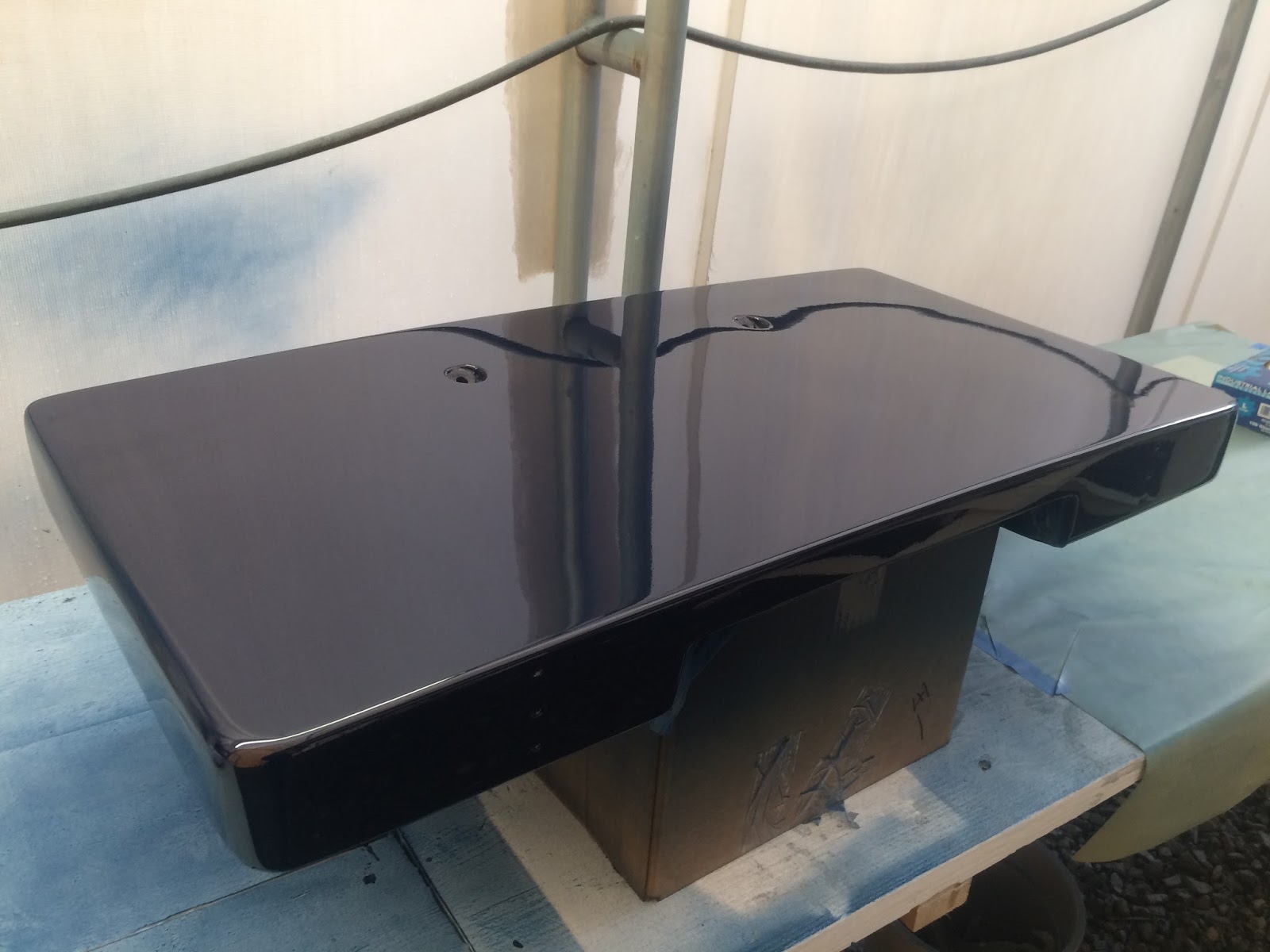
The Swim Platform

Jerry and Chris, The Painters
(Thanks Guys)
Now its time to remove the tape and covering, pull it out of the paint shed, and start to reassembling the boat.  This will start with the hatch covers and the rudder.

The Rudder

The rudder has been much more of a major project than I expected when I purchased it.  I was told that the manufacturer had manufactured at least one before.  But once the yard started to attempt to install the rudder it became apparent that there was still much work to complete on the rudder.

Rudder in the Box Last Fall

Rudder in Initial Condition
As you can see from the "In the box" picture, the rudder has has beautiful straight stock that is smaller than the steel bearings.  The problem is that the connection the rack to the stock on the original rudder is made for a stock that is the same size top to bottom.  Therefore, the crew at Milford Boat Works had to add more carbon fiber to get the diameter of the stock to fit the rack.  This is shown in the following video (The Rudder in Process) and the following picture, if you look carefully. 


The Rudder in Process

Finally, a stainless tube had to be inserted inside the stock and a pin, (that you can see in the following picture and video), to fit the emergency tiller.

The New and Old Rudders Currently

Details of the New and Old Rudders

With this work complete, the rudder is ready for installation.  My understanding is that this will be completed before Calypso is moved from the paint shed.

Varnishing the Companion Way Components

All sailboat companion ways get a great deal of traffic and more sun than the rest of the boat.  Consequently, they get more beaten up, and look it.   This was true of Calypso from the time I first saw her.

One of the Companion Way Boards

The Stairs that Attach to the Board

Shortly, when the weather warms up some more, I will start into varnishing these companion way boards and others in preparation for reassembly.  Additionally, I will add a post on implementing a non-skid surface to the stairs (I've been doing some experiments and found something that I really like.

More Soon.


Thursday, February 15, 2018

The C&C 121 and The Ideal Used Performance Cruiser: Part 1, Sailing

Calypso with her Roller Furling Spinnaker Rigged

Realizing that I'm more than just a little outspoken, to start, my personal opinion of the C&C 121 is that it's one of the best performance cruiser in the 40' to 50' range in the used sailboat market, at least for one who just retired from racing; I raced over 55 years.

I will say this despite all of the time, effort, and money that I've sunk into Calypso to rehabilitate her for blue water cruising.  I spent a lot of time looking at boats over the 65+ years I've spent sailing and racing.  I fantasized about owning a 121 since I first saw an ad for them in 1999.

After I bought the boat load of problems, as discussed in other posts in this blog. I still find her to be the best performance cruiser (or racer/cruiser) around.  And I've been to the Annapolis Boat Show three times since 2013 looking at brand new boats up to 60+ feet.  Additionally, since I've decided to start blue water cruising, I went ahead and have been reading many boats on "the best" designed cruisers by several authorities on cruising.

With the exception of one author (who was laying out the interior for a 30' to 40') all would agree that the interior design of the C&C 121 is ideal or close to it.

In this post/part I will discuss performance, handling, and safety reason I feel this is true.  In the second, I will discuss my reason with respect to livability and comfort in a second post/part.  Then I will discuss possible improvements--there are always ways to improve (customize) anything, no matter how perfect.


Pluses

Obviously, if I claim that the C&C 121 is the best performance cruiser in its class, then I must have some reasons for the claim.

Boat's Performance Under Sail

The first is that the C&C 121 has superior maneuverability/handling/balance, enabling sailor's like myself, to get out silly predicaments that they get themselves into.  At any speed above a 1/2 a knot the boat will turn in its own length.  A blue water sailor, who sailed with me could not believe the G-forces in a sharp turn at 6.5 knots.

Be that as it may, Larry, the yard manager at Milford Boats Works proved to me that Calypso doesn't need a bow thruster by taking the boat out of the gas dock, from between two boats with about six feet between Calypso and each of them, through two 90 degree turns in very close quarters and into a space little more than 45 feet between two other boats.

It was amazing.  I wish I had taken a video of it.

The balance of the boat under sail is amazing.  Not since I sailed Pink Lady, my Lightning, have I had a boat that would stay on course without touching the steering for so long.  I could set up the lightning by moving the centerboard to change the center of effort.  There have been a number of occasions where I forgot to engage Otto-the-pilot and didn't realize it for more than 10 minutes.

With Starwood, my C&C 34, I was required to always watch the helm--30 seconds without watching it meant it has already turned 30 or more degrees off course.

The second is the boat's speed.  Very few boats of 40 feet have a hull speed of 11.75 knots.  I calculated it the using the equations found in The Modern Cruising Sailboat: A Complete Guide to Design, Construction and Outfitting, by Charles J. Doane.

I have some evidence that this is correct since I have frequently achieved over 10 knots with just a number 2 jib unfurled and once moved above 11 knots  for 15+ minutes up the Vineyard bay in a 20 to 30 knot wind.  That was with the main and the jib with the wind off the port quarter.  And Calypso is equipped for cruising, not racing (lots of things like microwave, TV, etc. that no racer would have).

In fact, you can reduce sail area early with little reduction in speed.  In another post I have a video of Calypso going 9+ knots in a 15+ knot wind, and this has frequently happened in the past 3 years.

The reason that speed  is not to have cruisers win races, instead is important is that it increases the range. that is, If you move at 9 knots average over 24 hours, rather than 6 knots you are going sooner or to get out of the way of a major storm more quickly.  So you can choose a weather window of 3 to 4 day, rather than 5 to 7 days; and that makes a difference.

The third is the boat's pointing ability.  As a racing sailor for 55 years, I found that a boat's ability to point was one of the keys to winning races.  So I continuously and intuitively analyzed how to get the boat I was sailing to point a degree or two higher while maintaining the boat's speed.

With my Sailfish, Sunfish, Lightning, and on the Flying Junior's that I sailed at the University of Iowa, it was managing the sail trim, the location of the crew, and where the centerboard (or dagger board) was located.  

When I graduated to keel boats, with Starwood, my C&C 34 in 1995, I started to learn to work with larger sails and found out about their trim, which is substantially different from small working jibs.  Pointing, get as close to the direction that the wind is coming from by trimming the upper and lower part of sail and, in the right conditions, stalling the mainsail, can change how close the boat can get to the wind from around 40 degrees to about 30 degrees.

This difference of 10 degrees can make a world of difference both on the race course and upwind on a long slog.  While I understand from my reading and from social media that cruisers want to wait for the wind that is not right on the nose, like much else, it happens.

The sails that Calypso came with were 13 years old and both blown and worn out.  The jib is good for going most directions except upwind.  The reason is simple, I can't properly trim the jib or flatten the main.  When the bottom of the jib is in trim, the top isn't and vise versa. The result of this long winded explanation is that the boat has the potential sail at full speed at somewhere near 30 degrees, but the very best I can do normally, is about 37 to 39 degrees (and yes, very occasionally, I have been able to sail as near as 33 degrees without losing a great deal of speed).

The reason that I focus on the boat sailing characteristics is that it is what sailing is all about.  If sailboat cruising was all about anchoring and partying, that can be done better in a power boat.  If sailing is really all about how comfortable the boat cabins and heads are, that is better in a power boat.  But, if it's the pure joy of getting the boat to dance through the choppy and heaving seas in a 20 knot wind, with the spray flung into rainbows and the rail near the water, then it's sailing and a real performance cruiser is best.

Many cruisers and cruising boat manufacturers claim that cruising boat must of short masts (where the boom is half or more the length of the mast) to have good "seakeeping ability".  In fact many cruising boats that I've seen have mast lengths anywhere from 90 to 110 percent of the boat's length.  This produces a nearly equilateral triangular sail with most of the sail area low.  By keeping the mast low, you don't need as deep a keel to balance the boat.

While I can understand some of the reticence of cruising sailors to have large sails, to this retired racer's mind, their reasoning is faulty (and actually, I've noticed more boats with taller masts, in comparison with the length in recently manufactured boats).

The reason I like a tall mast, that is, 1.4 times the LOA is that it can hold a sail that produces more lift.  If you look at the mean chord (width) of aircraft wings since the Wright brothers, you will see that the wings have become successively narrower while the weight of the aircraft has continued to increase.  

Again, looking at the latest racing boats; their masts seem to be taller and the sails narrower in comparison with previous models.  And the foiling boats with ridge "wing" sails, like the AC75s, have very narrow wind foils and produce significant power.

From my reading of the cruising authorities, one reason for short masts, with low aspect ratio for sails is to keep the center of effort of the sails low which makes the boat ride better in a storm.  They say this is especially true for heavy slow cruising boat.

For both the C&C 34 and the C&C 121, in heavy air, 20 to 35 knots average with gusts to 45 knots, I've found that sailing under a #2 Jib only produces a highly controllable at all points except dead downwind.  The reasons for this are pure physics.

With the wind on the quarter to just ahead of the beam, the reasons the center of effort for the sails is forward of the mast, so the sail is simply pushing the boat along.  On my Lightning and on the FJs, we would lift the centerboard to keep the helm neutral, while running we would have both the very large spinnaker (for the size of the boat) and the centerboard up.  In winds over 20 knots, this allowed us plane and produce a powerboat wake.

With a keel boat, you can't change the hull/keel shape depending on the direction, (unless it's with a swing keel or foils, maybe).  However, by using the main traveler (that is not available on some of the new European boats because its not used by the average charterer--not surprising) and using movable jib cars, you can have a great deal of control at almost any wind speed as long as you are sailing between on-a-tack and about 170 degrees off the wind.

Those 10 degrees on either side dead downwind are really not wise to head in, if the wind is above about 8 knots.  There are several reasons.  The first is safety.  With waves astern it's easy to slew around as they build.  

I found this out the hard way when I was between 12 and 14 years old sailing my Sailfish off a Lake Michigan beach.  I tried coming in dead downwind with the waves and ended up half drown with the boat washing up on the beach on its side.  However, when I aimed about 10 degrees off dead downwind, I could bring her in safely and fast even in 6 to 8 foot breaking waves.  

N. Calder calls this "running off" though it might be more aptly named "surfing".  It's fun if you have practiced it, otherwise, it's exciting (read that as a "white knuckle sail").


Deck Layout and Boat Handling

But the seemingly arrogant statement that "the C&C 121 is the best performance cruiser" can't be limited to its sailing characteristics, the boat must provide excellent gear, well located for sail handling, and good to great accommodations so that the boat can be lived in at sea, at anchor, or on the dock.

I feel that the deck layout and equipment is among the best I've seen for several reasons.  The first reason is the deck design and the layout of the equipment facilities a "full crew" of one or two people.  All of the lines of the running rigging are led to the cockpit.  And, as shown in the following picture, it makes for many lines.


Winches and Lines Under the Dodger


The deck equipment is laid out, equipped, and sized for racing; something that many cruiser might say is unnecessary and outright counter cruising.  Well, I would submit that, "that ain't necessarily so."  

The reason that many cruisers would hold that a well equipped racing boat is not a good cruising boat is that on a racing boat there are a great many more lines for shaping the sail for wind conditions and pointing angle than necessary for cruising. This means that many more crew are needed.  

Actually, NOT!  The point of having having a boat well equipped for racing is that the blocks, winches and lines are sized for heavy conditions and a normal sized people--not deck apes, rail meat, and knuckle draggers.  Under most conditions petite winch wenches should be able to trim the jib.

In heavy conditions I typically have only enough sail showing that anyone can haul it in.  Above 12  to 15 knots I found that racing my C&C 34 with a symmetric spinnaker was exciting, unsafe, and did not enable me to beat the other guy.  Instead, we had jibe downwind or go into an occasional death roll.  So I see no point in having anything but the jib and main up in any wind above 12 knots on Calypso for cruising.


Calypso Sailing under Jib Alone in an Easy Breeze

And, above 20 the main will be furled.  My experience has been that with only the jib up in winds above, the boat still comes close to hull speed at all points of sail.  (an aside: Unless constantly practicing like the pros, a racing sailor will always take two or more years to find "the grove" or "the sweet spot" of a particular boat, that is the spot where the speed and pointing ability make the boat as fast as possible on the race course for the wind conditions.)


Winches

Another nice things about having the deck layout with the size and number of winches.  The blocks set up for racers who tend to push their boats to the limit and beyond. so "over-sized" winches for cruising are standard for racing.

Over the years I've sailed on a number of "cruising boats" and noted the dearth of winches and other equipment for sailing handling.  I found that on several boats designed for cruising, that apparently the designers assumed that the boat would not be sailed in heavy air, because I could see no way you could grind the jib in.  Additionally, with winches located on the mast, it could be very tricky, exciting, and out right dangerous to shorten sail in heavy air--the less time you spend forward in heavy air the better on a cruising boat.

My C&C 34, Starwood, came with 12 winches mounted all over the boat--every halyard and sheet had its own winch.  All the winches except the outhaul winch were mounted behind the mast on the deck or in the cockpit.

It was set up this way so the boat's crew could change head sails while going down or up wind--which we did at least 2 or more times a season--that standard maneuvers spinnaker jibes, take downs, tacking, and so on could be done in a minimum of time with a full crew (6 to 8).  Sometimes I had that number sometimes not.

Additionally, the added winches could help alleviate problems--like when an inexperienced crew member over wrapped a jib sheet. 

This is a problem when you are cruising or short-handed racing the C&C 34 with this deck layout is that without a full crew, crew members are running around the deck to get all of the work done.  It also meant that I never used any of the spinnakers when I cruised the boat.

During the 1980s and 90s, designers of racing boats changed the deck layout design, I think in part, to alleviate the problems with finding crews and sailing short-handed.  So, Calypso has only 6 winches; 6 large winches.  With both primary and secondary winches


The Cockpit showing the Winches and Other Gear

I've also noticed winches on the mast--interesting in a blow.  I've noticed that most sailors would prefer not to be forward of the cockpit when the weather turns gnarly. In fact, many suggest braces or brackets around the mast for body and handholds while reefing. 

Calypso's Deck forward of the Cockpit

Lines from the mast led under the deck to the Cockpit

The lines from the mast are in two tunnels under the deck.  There seems to be a small trend for most top racing boats (e.g., the Volvo 65s) and new cruising boats to have tunnels to the cockpit for their forward lines.  This clears the deck of many things to slip or misstep on.  It also makes tying something to the deck or simply sitting on it in good weather much more comfortable.

Rod rigging

With a 3 spreader rig and the stays well inboard of the toe rail (see the picture above) you have a clear walkway from the cockpit to the bow.  This means that when you rig the jack lines for offshore sailing there is no need to unsnap the harness and reattach on the other side of the stays.  Actually, with all of the working lines led to the cockpit I see little need to go forward in heavy air.

Still if there is a need to go forward in heavy air it's nice to be able to feel secure and not have to mess hooking up and then unhooking going around the stays.

Some sailors would rather have wire rope than rod because of the difficulty in spotting problems that would lead to rig failure.  However, my experience has been very different.  Twice on the O'Day 23 that I owned unexpected had a wire rope stay part.  Also on a number of Lightning and PHRF racers, that I raced again lost their masts because their wire rope stays parted.

However, on SV Starwood, my 1980 C&C 34 had never had any problems with its rod rigging.  When I sold it (and since) not one stay had ever been replaced; 37 years.
The Rod Rigging on Calypso's Mast
So I'm not so sure that rod rigging is less dependable than wire rope.


Depth of Cockpit


According to several sailboat design books and my own thinking, the cockpit depth of the  C&C 121 is not to shallow, not to deep, but just right for blue water cruising.


Aft Part of the Cockpit

The Forward Part of the Cockpit

According to the various world cruising authors, a cockpit that is to deep with to little drainage can be very dangerous in a blow because a great weight of water can collect in the cockpit.  This is especially true if the scuppers are small and drain the water slowly.

On the other hand, most new racing boats the top of the transom is even with the the deck of the cockpit.  This means the any water that lands "in" the cockpit will run right off; there's nothing to dam it up.

On the other hand, beyond about 150 degrees on either tack, there is nothing from preventing a wave from sloshing on board.  This and the fast movement off the deck and over the transom, despite lifelines would make me feel this is risky; there is a significant weight to moving water.

Therefore, as you can see in the pictures, above, for me, the C&C 121 is ideal (again).  


The Jib Sheet Tackle

While it may seem like a little thing and weird at the same time, the fact that the jib sheets are "set up for racing" I deem as extremely important for the safety and speed of any cruiser.

The "tackle" includes movable jib cars with their lines led to a point where the jib leads can be trimmed by the helmsman.  There is a turning block slightly outboard and behind the primary winches.  This allows the jib sheets a clear path and enables either the crew or helmsman to adjust the sheets.  This makes single-handing the boat feasible.

Additional Thoughts and a Look Ahead to Part 2


If you read books by or talked with cruising sailors up to the 1990s, you would read or here that a rounded full keel hull was the by far the best for blue water, and especially one with a rounded stern.  In other words, one designed in the 19th or early 20th centuries.

The reason for them saying this is that these round slow boats, roll more and toss and bounce less.  But, actually they roll more according to what the latest information from various cruising authorities indicate.  

I've run into several cruising authorities, on the web, have indicated that the hulls and rigs designed for racing may be better for rough weather because they don't roll as much, rather they cut through the waves, except for the occasional slam into an unusual one or if the periodicity of the waves and the length of the boat somehow match.  And Is it better to be bounced around for 2 days and move fast, or bounced around somewhat gentler and rolled a lot more for 3 days?

But there's another consideration; the proverbial weather window.  In the middle latitudes to near the tropics a window of good weather occurs for two to six days between low pressure systems. [Yes, I taught weather and climate in the late 1960s, having informally studied it from the time I was three years old.  I will post a presentation that I've made to local diving and sailing clubs in a future post.]  

In a fast boat, 8 to 10 knots boat speed, you can make a much greater distance in a given period than one that makes 5 to 7 knots in the same winds.  This means that weather windows not suitable for getting to where you are planning to go in a slow boat, you can make easily in a fast boat.  So I would choose a performance cruiser everytime.

I will discuss why the interior is close to ideal for blue water performance cruising in part 2 of this tome.  It, too, is ideal for a performance cruiser in the 40' range.

I repeat, I believe that the C&C 121 is as close as any boat to ideal for a performance cruiser as any boat you can find on the used market.

If you disagree or have comments, please post them.


Tuesday, January 30, 2018

Winter 2017 to 2018: Completing the Refit Part 6, Waiting, the Boom, the Bottom, and the Transom

Waiting

This is the first post for 2018.  Milford Boat Works is still in the process of getting the boat ready for painting.  Currently are still priming the topsides.  Parts are coming in and its cold and dark.

This is typical of the way most sailors feel, except for those who sailed south in the fall or fly south for a charter sail.


The Boom

Chris Ranney from Tartan Yachts sent me a couple of pictures of the nearly completed boom.  Here they are.  I plan to go out to see it on my way to Michigan shortly.

The Aft End of the New Boom

The New Boom Looking Toward the Aft End
Then today, today being Jan 29th I visited Tartan Yachts and saw the boom...FINISHED.   Gorgeous!!!  Here are two videos.


The Pocket Boom
(Held the camera in portrait instead of Landscape; oh well I was excited)

The Bottom of the New Boom Showing Attachment Points

As you can see from the videos, the boom is shaped like a trough so that new full batten North mainsail will fall directly into it instead of all over the bimini and cockpit.  This should make using the main faster and simpler.


Todd who actually made the Boom
(Thanks Todd)

The Bottom

The bottom paint of Calypso has been a problem since I acquired it in 2014.  The reason is that I couldn't find out what the paint was.  Most of you know that most brands of bottom paint are incompatible with other brands; meaning they will not adhere properly and flake off.  This defeats the purpose of bottom paints.

Larry and his team at Milford Boat Works found a water-based paint that would work for a year.  But that meant the bottom needed to be completely repainted every year.  On my old boat, Starwood, I only needed to have the leading edges of the keel and rudder, and near the waterline repainted; these are the areas of most wear on the paint.

In the winter of 2015/16, the yard personnel found that the keel bolts had slightly loosened; not good.  And there seemed to be cracks on the keel in the joint; again, not good.  So it was not surprising when the bottom was media blasted to get rid of the old paint, the some of the fairing material on the keel fell off.  This is shown in the following picture.


Keel After Media Blasting
(Note the Lead in the circled area)

So there was one more preparation job for the yard before the bottom could be barrier coated on painted.  Finally, as shown below the fared area was painted with a sanding primer, as was the entire keel (see a previous post).  This is shown in the following picture.

The Keel and Bottom After Fairing and Some Primer
Now is was time to paint the bottom.  The same portion of the keel and bottom is shown in the following picture. 

The Completed Keel and Bottom Paint

It wasn't just the keel and its connection that was painted, it was the entire bottom, after it was barrier coated.  The paint was rolled on instead of sprayed, which make the paint a little bumpy or dimply.  If the boat was to be used for racing at the highest level, that might be a problem.  

However, even when I was racing SV Starwood I rolled the paint on.  Having an ultra smooth bottom helps the speed, but one mistake by the crew can cancel out all of the speed advantage of a smooth bottom.  Since I'm using Calypso for cruising and since the cost of spraying might be up to double the cost of having the paint rolled, I chose the latter.


The bottom paint is now ready for the water.  I wish the rest were, but it's coming along.  Here are the two sides of the bottom in the two videos.


The Port Side showing the bottom Paint


The Starboard Side Showing the Bottom Paint

The new rudder has been painted as well.  This rudder has been much more of an effort on the part of the yard, than either the yard or I expected.  I'm planning a post on the problems with this new rudder in the future so that you might have some good questions to ask before you have one built.


The Rudder

The Transom

The transom of Calypso was filled with spider cracks.  You can find the pictures of these in previous posts.  In the last post, you could see that there was still a significant amount of smoothing that needed to be done before the transom was ready for paint; now just a little, according to Larry, the yard manager.

The Transom Primed and just about Ready
So now the boat is about ready for paint, then reassembly.

I suspect I'll be waiting until the end of February or early March before I can show you much more progress.  So I'll be waiting.


Monday, December 25, 2017

Winter 2017 to 2018: Completing the Refit Part 5, Epoxy, Priming, and more Parts

Epoxy (The Transom)

During the late October and all of November, the yard personnel did little work on Calypso because they were busy hauling boats for the winter and winterizing them.  Part of the reason that I brought Calypso over early was so that they could get as much work as possible completed before fall hauling season.  Consequently, I've really posted no new pictures or videos of the boat recently.

They are back working on the boat and will complete a good portion of the work before the holiday break.  They have already completed a significant amount work.


The Transom

As you might have seen in some of the pictures and videos in past posts, the transom needed some work; well it's begun.  The transom is a reverse transom and therefore sometimes points directly into the summer sun.

Since it's Awlgripped in Flag Blue, which is close to black, it heats up.  This heats the gelcoat under the paint and the gelcoat spider cracks.  I have pictures of these spider crack in a previous post.

The people in the yard sanded down the Awlgrip and gelcoat mostly down to the epoxy of the hull.  Then they epoxied a layer of glass mat to the surface as shown in the video about.  After some additional prep work including sanding, the transom will be ready for primary.

The combination of glass mat and epoxy had much less chance of spider cracks than the gelcoat.  So, the new surface should be much better adapted to the sun, especially in the Caribbean.  So if I go there...

Priming

All the rest of the topsides have had two or three coats of sanding primary applied as shown in the following two videos.

 
The Port Side in Sanding Primary

The Starboard Side in Sanding Primary

Additionally, the cracks around the keel have been smoothed out and primed.

Keel before Smoothing and Priming

Keel After Smoothing and Priming
After the transom is smoothed out the topsides  will need another two to three coats of sanding primer before its ready for the Awlgrip.  The Keel too will need two or three coats of sanding primer, but will be followed by a barrier coat and bottom paint.

More Parts

The hatch lids have come back from Hatchmasters with their new lens and are ready to be fit back onto their frames.  Here some of them are.

The Hatch Lids
It's likely to be early March 2018 before they are assembled on the boat.

The new rudder has finally emerged from its box, as Larry the Milford Boat Works manager and his team are starting to fit the rudder to the boat.

The Old Rudder

The New Rudder

As you might be able to see from the two pictures, the new rudder has a slightly different shape (slightly more hydrodynamic) than the old rudder.  Competition Composites Inc. did a excellent job on that part of the rudder.

Unfortunately, there have been a fair number of issues with the rudder post.  Most of the issues the people at Milford Boat Works have solved.  Still there is one issue important to me.  The emergency rudder fits onto a support passing through the center of the rudder post.  It's not there, so there will need to be more work on the rudder post.

Finally, the swim platform has been refurbished, primed, and with a few additional coats of primer will be ready for paint. 


The Swim Platform

Work will resume on the refit in early January 2018.